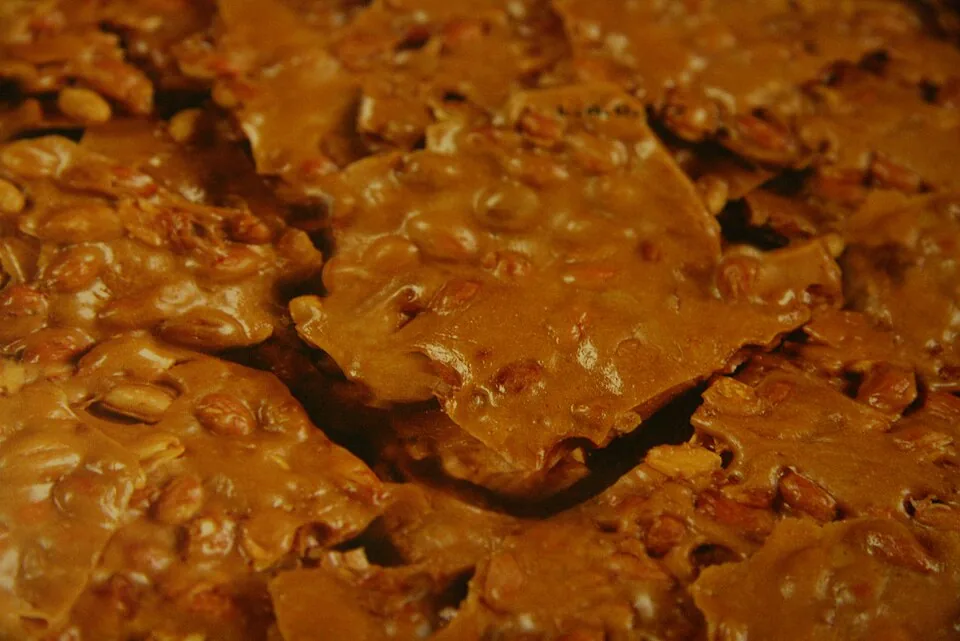
Peanut Brittle
Glassy homemade peanut brittle with roasted peanuts, snapped into shards for tins and gifts.
Updated: Oct 7, 2026
Why you'll like it
- Ready in about 50 min.
- Serves 20 — easy to halve or double.
- Medium level — everyday equipment only.
- Storage, freezing and reheating covered below.
Ready in 50 min, this peanut Brittle serves 20. Peanut brittle is a classic USA Christmas candy, poured thin so it shatters into glassy shards studded with roasted peanuts.
Helpful guides
Instructions
Butter a large rimmed sheet pan generously and set it near the stove with the measured peanuts, butter, soda, and vanilla within reach. Sugar work moves too fast for gathering ingredients mid-boil. A warm pan in a 200-degree oven spreads the candy thinner, if desired.
Combine the sugar, corn syrup, water, and salt in a heavy 3-quart saucepan over medium heat, stirring until the sugar dissolves and the mixture boils. Clip on a candy thermometer without touching the pan bottom. Dissolved sugar before boiling prevents grainy crystals later in the brittle.
Boil without stirring until the thermometer reads 280 degrees, about 10 minutes, then stir in the peanuts. The nuts cool the syrup slightly before it climbs again. Continue cooking, stirring often, until the mixture reaches 300 degrees hard-crack stage and turns deep amber.
Remove from heat immediately and stir in the butter, vanilla, and baking soda quickly. The mixture foams up lighter in color as soda aerates the candy. Work fast but carefully, since 300-degree sugar burns skin instantly and sets within a minute or two.
Pour onto the buttered pan without scraping the pot, then tilt and spread thin with a buttered spatula. Scraped pot bits taste bitter and seed crystals into the smooth sheet. Thin candy shatters crisply; thick pools turn tooth-sticking instead of glassy and light.
Cool completely at room temperature for 30 minutes until hard and clear-sounding when tapped. Snap into shards by hand or with a mallet, discarding any chewy spots. Pack cooled brittle promptly so humidity cannot soften the glassy texture before gifting or serving.
Troubleshooting — fixes, not repeats
- If the brittle turns chewy, it undercooked below hard-crack stage. Cook to a full 300 degrees on an accurate thermometer, testing it first in boiling water for 212 degrees. Humid days also soften candy; choose dry weather and store airtight the moment it cools.
- If the sugar crystallizes and grains, crystals splashed on the pot walls seeded the batch. Stir only until dissolved, brush walls with a wet pastry brush, and avoid stirring during the boil. Starting with clean equipment prevents most graininess in candy.
- If the brittle tastes bitter, it cooked past 310 degrees or scraped pot residue went in. Remove promptly at 300 degrees deep amber, pour without scraping, and work over steady medium heat. Dark spots from scorched sugar cannot be fixed once stirred through.
- If peanuts taste raw, they were added too late or the batch too cool. Use roasted peanuts stirred in at 280 degrees so they toast through the final climb to 300. Raw peanuts steam in the syrup and stay soft instead of crunching in the finished sheet.
Make it your way
- Spicier version: Stir in 0.5 teaspoon of ground cinnamon with the soda for spiced holiday brittle.
- For a large dawat: For a party trick, pour half the batch thin for shards and leave half thicker for chunky bites.
- For mixed-nut brittle, replace the peanuts with 2 cups of mixed roasted cashews, almonds, and pecans using the same temperatures and timing.
- Add 1 teaspoon of chili powder for sweet heat that pairs with the salty nuts.
Storage & reheating
Cool leftovers within 2 hours, then refrigerate in a covered container and use within 3 to 4 days. Reheat only the portion you will eat until steaming hot throughout — poultry and reheated rice should reach 165°F (74°C).
Freeze up to 3 months in airtight bags; thaw unopened at room temperature.
FAQ
Do I need a candy thermometer?
Yes for reliable results. Hard-crack stage at 300 degrees is nearly impossible to judge by color alone, and 10 degrees decide chewy versus glassy. Clip the thermometer without touching the pan, test it in boiling water first, and watch closely after 280 degrees when the temperature climbs fast.
Why add baking soda?
Baking soda foams in the hot syrup, creating thousands of tiny air bubbles that lighten the texture so teeth shatter the sheet instead of wrestling it. Stir it in off the heat and work fast. Too much soda tastes soapy, so measure exactly 1 teaspoon for this batch.
Can I halve the batch?
Yes. Halve all ingredients and cook in a 2-quart saucepan, watching the thermometer since smaller batches climb faster. Pour onto a buttered quarter-sheet pan. Timing shortens by several minutes, but the 280-degree nut addition and 300-degree finish stay exactly the same.