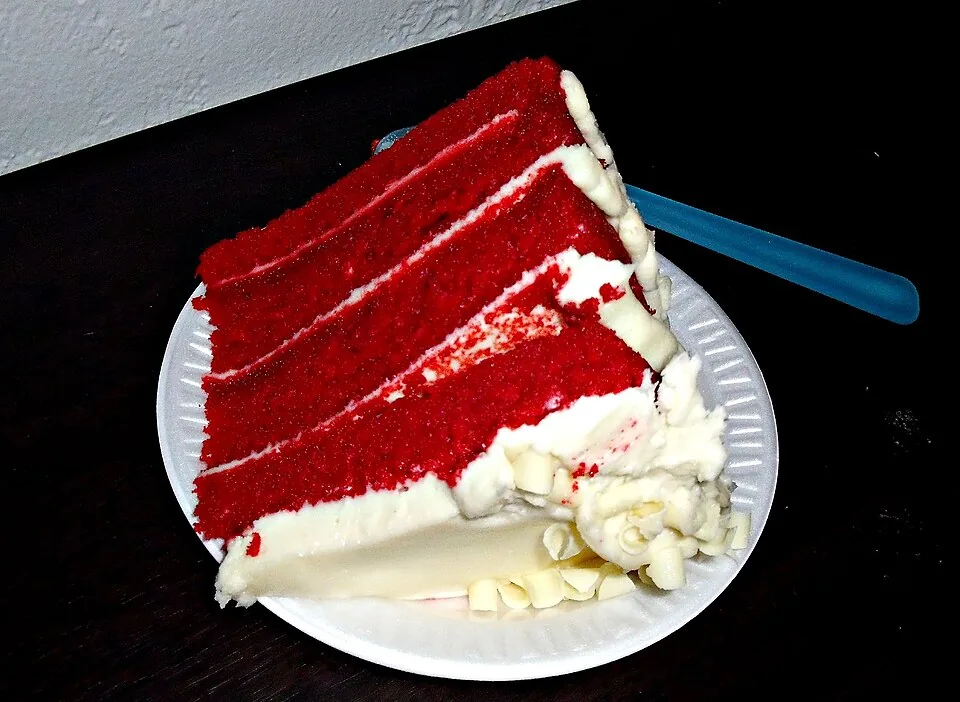
Red Velvet Cake
Deep-red cocoa layer cake with tangy cream cheese frosting, portioned for birthdays and holiday gatherings.
Updated: Oct 7, 2026
Why you'll like it
- Ready in about 1 hr 30 min.
- Serves 12 — easy to halve or double.
- Medium level — everyday equipment only.
- Storage, freezing and reheating covered below.
Ready in 1 hr 30 min, this red Velvet Cake serves 12. Red velvet cake is a Southern-born layer cake served at birthdays, holidays, and weddings across the USA, known for its deep red crumb and tangy cream cheese frosting.
Helpful guides
Instructions
Heat the oven to 350 degrees and grease two 9-inch round pans, then line the bottoms with parchment and dust lightly with flour. Set the buttermilk, eggs, and dairy out 30 minutes ahead, since room-temperature ingredients blend smoothly and trap air. Prepared pans release clean layers without tearing.
Whisk the flour, sugar, cocoa powder, baking soda, and salt in a large bowl until evenly combined and lump-free. Whisk a full 30 seconds, since pockets of cocoa or soda cause dark streaks and uneven rise. Natural cocoa suits this recipe better than Dutch-process, which dulls the red color significantly.
Whisk the oil, buttermilk, eggs, food coloring, and 1 teaspoon of the vanilla in a second bowl until smooth and uniformly red. Oil keeps the crumb moist for days, while buttermilk adds the gentle tang that defines red velvet. Confirm no egg streaks remain before combining with the dry mixture.
Pour the wet mixture into the dry ingredients and stir gently just until smooth, then stir in the vinegar last. The vinegar reacts with the baking soda for extra lift, so move promptly to the pans. Divide the batter evenly between pans and smooth the tops for level layers.
Bake 28 to 32 minutes until the tops spring back lightly and a toothpick in the center shows a few moist crumbs. Rotate the pans once halfway through if your oven browns unevenly. Overbaking dries the crumb quickly, so check at 28 minutes.
Cool the layers in the pans for 10 minutes, then turn out onto a wire rack, peel off the parchment, and cool fully for 1 hour. Beat the cream cheese, butter, powdered sugar, and remaining vanilla until smooth, then frost the cooled layers. Never frost warm layers, which melt frosting.
Troubleshooting — fixes, not repeats
- If the crumb bakes brown instead of red, the cocoa was too dark or too heavy. Use natural cocoa at exactly 2 tablespoons and liquid red coloring, since gel tints vary. Dutch-process cocoa plus low coloring produces muddy maroon, not classic red.
- If the cake turns dense or gummy, the batter was overmixed or measured flour ran heavy. Stir only until smooth, spoon flour into cups without packing, and move vinegar batter into the oven promptly. Overworked batter toughens the tender crumb.
- If the frosting turns soft and slides, the cream cheese or butter was too warm. Chill the frosted cake 20 minutes to firm it, and beat only until smooth, not fluffy. Full-fat block cream cheese sets firmer than tub or low-fat versions.
- If layers dome or crack, the oven ran hot or pans sat too high. Check temperature with an oven thermometer, bake on the middle rack, and trim cooled domes flat with a serrated knife. Level layers stack neatly with less frosting.
Make it your way
- For a large dawat: Stack three 6-inch layers for a tall party cake with extra frosting between tiers.
- For cupcakes, divide the batter among 24 lined cups and bake 18 to 20 minutes at 350 degrees.
- For a 9-by-13-inch sheet cake, bake 30 to 35 minutes and frost the top only.
- Add an extra tablespoon of cocoa for stronger chocolate flavor with slightly deeper color.
Storage & reheating
Cool leftovers within 2 hours, then refrigerate in a covered container and use within 3 to 4 days. Reheat only the portion you will eat until steaming hot throughout — poultry and reheated rice should reach 165°F (74°C).
Wrap unfrosted layers tightly and freeze up to 2 months, then thaw overnight in the refrigerator.
FAQ
Can I use Dutch-process cocoa?
Yes, but expect a darker, less red crumb. Natural cocoa is acidic and reacts with vinegar and baking soda for lift and color. If using Dutch-process, keep the vinegar, add an extra teaspoon of coloring, and watch doneness closely.
Can I use less food coloring?
Yes, with a color trade-off. Halving the coloring gives a dusty rose crumb that still tastes the same. Beet powder tints weakly with earthy notes; use it only for small batches. For the classic look without liquid dye, use 2 tablespoons of gel color thinned in the buttermilk.
Can I bake the layers ahead?
Yes. Bake layers up to 2 days ahead, cool fully, wrap tightly in plastic, and refrigerate. Freeze up to 2 months for longer storage. Frost only when layers are fully cool and firm; cold layers spread frosting cleanly with fewer crumbs. Level domes before stacking for straight sides.